If you’ve spent any time searching for an AI and ML roadmap, you already know the problem: there are a thousand YouTube playlists, a hundred “complete roadmaps,” and almost none of them tell you what actually gets you hired.
I run EzTechExplains, where I break down CS and data concepts for students who are tired of bloated university curricula and vague course promises. I’ve built and shipped real projects, mentored students working through the same confusion you’re probably experiencing right now, and put together this roadmap based on what actually moves the needle—not what looks good on a syllabus.
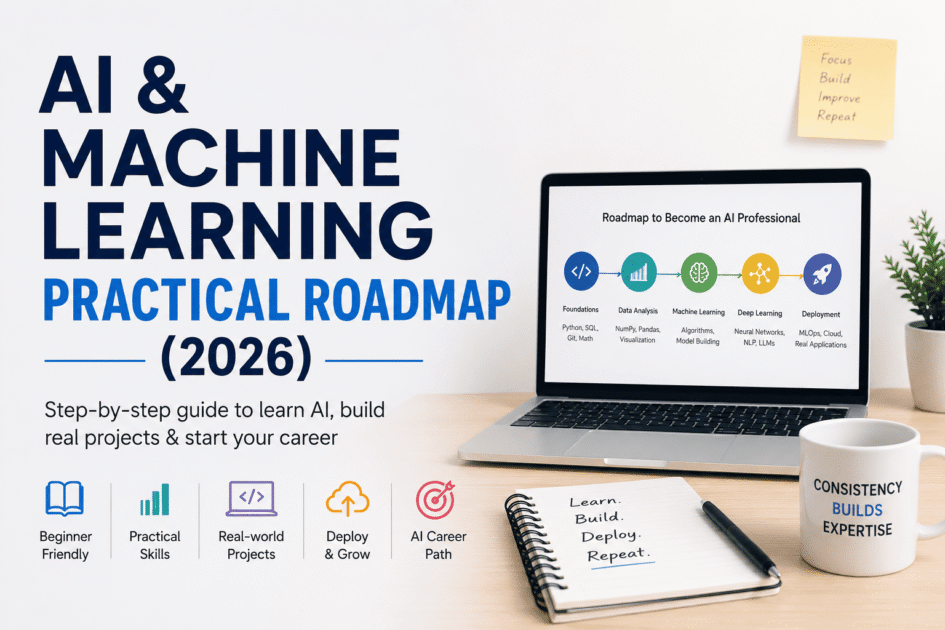
That confusion is exactly why most beginners quit within a month. This guide fixes that by giving you one clear, practical AI and ML roadmap for 2026 — the actual order skills build on each other, what to learn at each stage, and how to avoid the mistakes that stall most self-learners.
Key Takeaways
| Stage | What You’ll Learn | Practical Goal |
| Foundations | Python, SQL, Git/GitHub | Write and manage real code |
| Math | Linear algebra, stats, calculus | Understand how models actually learn |
| Data Analysis | NumPy, Pandas, visualization | Clean and explore real datasets |
| ML Fundamentals | Supervised/unsupervised learning | Understand how ML solves problems |
| Core Algorithms | Regression, trees, clustering | Build your first working models |
| Deep Learning & NLP | Neural networks, transformers | Work with text, images, and LLMs |
| Generative AI & Agents | RAG, prompt engineering, agents | Build with modern AI tools |
| MLOps & Deployment | Docker, cloud, APIs | Ship models beyond the notebook |
| Projects | Beginner to advanced builds | Create a real portfolio |
| Portfolio | GitHub, LinkedIn, Kaggle | Get noticed by employers |
What’s the Best AI and ML Roadmap for Beginners in 2026?
The best AI and ML roadmap for beginners in 2026 starts with Python, SQL, and basic math — not machine learning itself. From there, move into data analysis, core ML algorithms, deep learning, and, finally, generative AI and deployment, building real projects at every stage rather than just watching tutorials.
What Are AI and Machine Learning?
Artificial intelligence is the broader idea of building systems that can perform tasks that normally require human intelligence — recognizing images, understanding language, or making decisions.
Machine learning is a subset of AI. Instead of programming exact rules, you feed a system data, and it learns patterns from that data to make predictions or decisions on its own. Deep learning, NLP, and generative AI are specialized branches of machine learning.
[Image suggestion: Simple diagram showing AI as the outer circle, ML inside it, and deep learning inside that — alt text: “AI vs machine learning vs deep learning diagram 2026”]
AI vs Machine Learning
| Aspect | Artificial Intelligence | Machine Learning |
| Definition | Broad field of intelligent systems | Subset of AI focused on learning from data |
| Approach | Can include rule-based logic | Learns patterns statistically |
| Examples | Chatbots, robotics, recommendation engines | Spam detection, price prediction, image classification |
| Scope | Umbrella term | One method used to build AI |
Why You Need a Structured AI and ML Roadmap in 2026
Randomly watching tutorials feels productive, but it rarely builds real skill. Without a roadmap, most beginners either learn things out of order (jumping into deep learning before understanding basic ML) or get stuck in “tutorial hell” — endless consumption with nothing to show for it.
A structured machine learning roadmap for beginners solves this by providing a clear sequence: foundations first, then core ML, and finally specialization. Each stage builds directly on the last, so nothing feels random.
You also don’t need to master everything before moving forward. The goal is steady progress, not perfection at every step.
AI and ML Roadmap for Beginners: Step-by-Step
Here’s the full AI and ML roadmap, broken into ten practical stages. Follow it roughly in order — skipping too far ahead usually means backtracking later.
Stage 1: Learn Python, SQL, Git and GitHub
Python is the language nearly every AI and ML tool is built around, so it’s the natural starting point. Learn variables, loops, functions, object-oriented programming, and file handling — then get comfortable with NumPy and Pandas.
SQL matters because real AI systems run on data stored in databases. Learn SELECT statements, JOINs, GROUP BY, and window functions using PostgreSQL or MySQL.
Git and GitHub aren’t optional extras — your GitHub profile becomes your portfolio. Learn basic version control, branching, and how to write a clean README.
Here you can start with simple Coursera tutorial Python for beginners.
https://www.coursera.org/courses?query=python&productDifficultyLevel=Beginner
Stage 2: Learn Math for AI and Machine Learning
You don’t need advanced, research-level math to start. You need working intuition in four areas:
- Linear algebra — vectors and matrices, which power neural networks and embeddings
- Statistics and probability — mean, variance, distributions, and hypothesis testing, used constantly in model evaluation
- Calculus basics — derivatives and gradients, which explain how models actually learn
- Optimization — gradient descent and cost functions, the mechanics behind training
[Image suggestion: Simple gradient descent curve illustration — alt text: “gradient descent optimization for machine learning beginners”]
Stage 3: Learn Data Analysis and Visualization
Before building any model, you need to understand your data. Master NumPy for array operations and Pandas for cleaning, filtering, and aggregating datasets.
For visualization, learn Matplotlib, Seaborn, and Plotly to build histograms, heatmaps, and correlation graphs. Practice exploratory data analysis (EDA) on public datasets — this step alone significantly improves how well your later models perform.
Stage 4: Learn Machine Learning Fundamentals
This is where core machine learning concepts start. Understand the three main types:
- Supervised learning — trained on labeled data (spam detection, price prediction)
- Unsupervised learning — finds hidden patterns without labels (customer segmentation)
- Reinforcement learning — learns through rewards, used in robotics and game AI
Also learn the basics of regression, classification, clustering, and how to evaluate a model’s performance using metrics like accuracy, precision, and recall.
Stage 5: Practice Core Machine Learning Algorithms
Once the concepts click, practice implementing them. Start with linear and logistic regression for prediction and classification. Move into decision trees and random forests, both widely used for real-world problems such as fraud detection.
Round this out with SVM, KNN, and Naive Bayes for classification tasks, and K-Means/DBSCAN for clustering. Use Scikit-learn — it’s the standard library for all of this.
Stage 6: Learn Deep Learning and NLP
Deep learning extends classical ML by using neural networks. Learn the basic architecture — input, hidden, and output layers — using TensorFlow or PyTorch, along with backpropagation, the core process behind how networks learn.
From there, explore CNNs for image tasks, RNNs/LSTMs for sequential data such as text and time series, and transformers—the architecture behind modern LLMs like GPT and Claude.
This naturally connects to NLP: tokenization, embeddings, and the basics of how large language models process and generate text.
https://www.coursera.org/articles/data-analyst-skills-video
Stage 7: Learn Generative AI, RAG and AI Agents
Generative AI is the fastest-growing area in the field right now, and it deserves its own focused stage in any modern AI roadmap 2026.
Start with prompt engineering — zero-shot, few-shot, and chain-of-thought prompting. Then learn RAG (Retrieval-Augmented Generation): chunk documents, generate embeddings, store them in a vector database like FAISS or ChromaDB, and retrieve relevant context for an LLM to answer questions accurately.
Explore frameworks like LangChain and LlamaIndex for building RAG systems, and try building simple AI agents — tools that can call functions, chain steps together, and complete multi-step tasks automatically.
Claude AI prompting Introduction
https://www.coursera.org/learn/claude-ai-and-prompting-for-everyone
Stage 8: Learn MLOps, Deployment and Cloud
A model sitting in a notebook doesn’t help anyone. This stage is what most beginners skip — and exactly why it matters so much.
Learn to deploy models using Flask, FastAPI, Streamlit, or Gradio. Get comfortable with Docker for containerizing your applications, and pick one cloud platform (AWS, Azure, or GCP) to learn its core services.
For more advanced workflows, explore CI/CD tools and pipeline/monitoring tools like MLflow, Airflow, and Kubeflow.
Stage 9: Build AI and Machine Learning Projects
Projects are non-negotiable. This is how you prove you can actually do the work, not just describe it.
Beginner projects: spam classifier, house price prediction, iris classification, sales forecasting
Intermediate projects: sentiment analyzer, fraud detection, resume screening tool, customer segmentation
Advanced projects: RAG-based chatbot, AI agent for automation, multi-agent system, deployed AI SaaS product
Stage 10: Build a Strong AI Portfolio
A strong portfolio is what actually gets you noticed. Keep your GitHub organized — clean code, proper READMEs, and live deployment links wherever possible.
Build a simple personal website showcasing your projects and resume. Share your learning progress and projects on LinkedIn, and use Kaggle to practice on real datasets and competitions.
Best Tools and Resources for AI and ML Learning
| Tool/Resource | Used For |
| Python.org / official docs | Core language reference |
| Scikit-learn | Classical machine learning algorithms |
| Kaggle | Datasets, competitions, and notebooks |
| Hugging Face | Pretrained models, NLP, and LLMs |
| TensorFlow / PyTorch | Deep learning frameworks |
| Google AI | Research, tools, and learning resources |
| Coursera / IBM SkillsBuild | Structured courses and certifications |
| Microsoft Learn | Cloud and AI fundamentals training |
Common Mistakes Beginners Should Avoid
- Tutorial hell — endlessly watching videos without building anything of your own
- Skipping projects — assuming courses alone are enough to prove your skill
- Ignoring math — leading to a shallow, surface-level understanding later on
- Avoiding deployment — stopping at the notebook stage instead of shipping something real
- Copying code without understanding it — this catches up with you fast in interviews
- Trying to learn everything at once — instead of following a structured, step-by-step path
How Long Does It Take to Learn AI and Machine Learning?
Realistic timelines matter more than motivational promises:
- Beginner to intermediate: 6–12 months
- Intermediate to advanced: 1–2 years
- Industry-level expertise: 3–5 years
There are no shortcuts here, and no guarantee of a specific job or salary just from finishing a roadmap. What actually matters is consistency — steady, regular practice beats short bursts of intense study every time.
FAQs
What is the best AI and ML roadmap for beginners?
The best roadmap starts with Python, SQL, and basic math, then moves into data analysis, core machine learning algorithms, deep learning, and finally generative AI — with real projects built at every stage.
How to learn AI and machine learning in 2026?
Follow a structured path rather than random tutorials: build foundational coding and math skills first, then move through classical ML, deep learning, and generative AI, while consistently building and deploying projects.
What skills are needed for machine learning beginners?
Python programming, basic SQL, foundational statistics and linear algebra, and familiarity with libraries like NumPy, Pandas, and Scikit-learn are the core starting skills.
Can a non-technical person learn AI and machine learning?
Yes. It takes longer without a technical background, but anyone willing to learn Python and basic math step by step can build real AI and ML skills over time.
Why does Python matter in machine learning?
Python is the primary language behind nearly every major ML and AI library — Scikit-learn, TensorFlow, PyTorch, and Hugging Face are all Python-based — making it the practical starting point for this field.
Conclusion
The AI industry is moving fast, and it’s not slowing down in 2026. But here’s what I’ve noticed watching people succeed versus stall out: the engineers who make it aren’t the ones who can recite the most theory. They’re the ones who can build products, deploy systems, solve real business problems, and adapt quickly as tools change.
Learning AI doesn’t have to feel overwhelming once you have a clear AI and ML roadmap to follow. Start with the fundamentals, build real projects at every stage, and don’t wait until you feel “ready” to start building — that feeling rarely comes on its own. Every real project you ship compounds your skill faster than another month of passive tutorials ever will.
The roadmap really comes down to one loop: Learn → Build → Deploy → Improve → Repeat.
Want more guides like this? Explore our other AI, machine learning, Python, and data science resources on EzTechExplains to keep building your skills step-by-step.