Introduction:
Most Data Science roadmaps online will think you it’s too difficult in the first five minutes. Too many tools. Too many skills. Zero clarity on where I have to start .
This one is different.
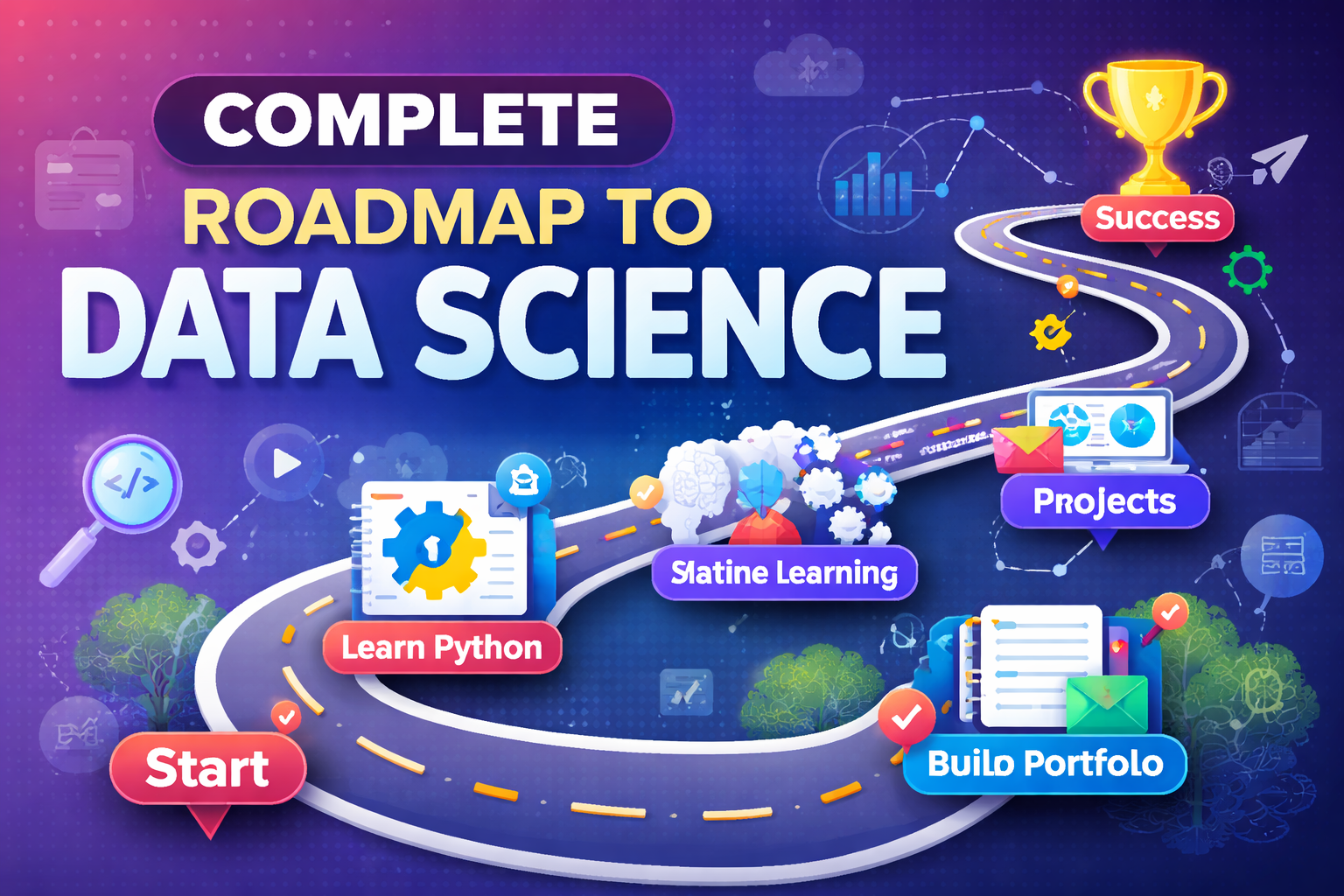
I am going to guide you through the exact step by step data science roadmap for 2026 in the right order, with free resources and a realistic timeline. Whether you are a complete beginner, a student, or a professional switching careers, this guide is for you.
Step 1: Build Your Mathematics Foundation
Timeline: 3 to 4 Weeks
I know. The word mathematics just made half of you want to close this tab. Please do not.
You do not need to be a maths genius to do data science. But you do need to be comfortable with three specific areas — and only three.
Statistics and Probability: This is the most important one. Statistics helps you understand your data. It tells you things like what the average looks like, how spread out the values are, and how confident you can be in a pattern you think you are seeing. Probability helps you understand uncertainty, which is everywhere in data science.
Linear Algebra: Do not panic at the name. At the beginner level, you just need to understand what matrices and vectors are and how basic operations on them work. Think of it as organized arithmetic.
Calculus (Basics Only) — Specifically, you need to understand the concept of derivatives, what they mean and what they represent. You will need this later when you start learning machine learning algorithms.
That is it. Just these three areas. And you do not need a university course to learn them.
Free Resources for Mathematics:
- Khan Academy — Free Math, Statistics & Probability https://www.khanacademy.org/math/statistics-probability
- StatQuest with Josh Starmer — Statistics on YouTube https://www.youtube.com/@statquest
- 3Blue1Brown — Linear Algebra & Calculus on YouTube https://www.youtube.com/@3blue1brown
Step 2: Learn Python Programming
Timeline: 4 to 6 Weeks
If data science is a kitchen, Python is your knife. You cannot cook without it.
Python is the most popular programming language in data science by a massive margin. It is beginner-friendly, it reads almost like plain English, and it has thousands of ready-made tools built specifically for working with data.
You do not need to become a full software developer. As a data scientist you need to cover basics like variables, loops, functions, and conditions and then moving into the data-specific libraries.
The three Python libraries every data scientist uses daily are:
NumPy: for working with numbers and mathematical operations on large datasets. Think of it as a super-powered calculator.
Pandas: for organizing, cleaning, and manipulating data in table format. If you have ever used Excel, Pandas is like Excel but ten times more powerful and fully automated.
Matplotlib and Seaborn: for creating charts and visual graphs from your data. Because seeing data is always better than just reading numbers.
Free Resources:
- Python for Everybody — Coursera (Dr. Chuck) https://www.coursera.org/specializations/python
- Kaggle Free Python Course https://www.kaggle.com/learn/python
- CS50P — Harvard on edX https://www.edx.org/learn/python/harvard-university-cs50-s-introduction-to-programming-with-python
Step 3: Learn Data Analysis and Visualization
Timeline: 3 to 4 Weeks
This is where you stop learning and start actually doing.
You will take real data, load it into Python, clean it up, and turn it into charts and graphs that tell a clear story. Think of it as finding the pattern — just like the doctor found the disease from symptoms.
What you will cover:
- Loading data from files and databases
- Fixing missing and messy data
- Summarizing data using basic statistics
- Creating bar charts, line graphs, histograms, and heatmaps
Free Resources:
- Kaggle Free Data Analysis Course https://www.kaggle.com/learn/pandas
- Tableau Public — Free Version https://public.tableau.com/en-us/s/download
- Google Data Analytics Certificate — Coursera https://www.coursera.org/professional-certificates/google-data-analytics
Step 4: Learn SQL For Data
Timeline: 2 to 3 Weeks
SQL is the language you use to talk to databases and pull out exactly the data you need.
Almost every company stores its data in databases. Almost every data job interview tests you on SQL. You cannot skip this step.
Where you will use it:
- Pulling data from company databases
- Filtering and sorting large datasets
- Answering business questions with data
- Every single data job interview
What you will cover:
- SELECT, WHERE, GROUP BY, ORDER BY
- Joins — combining data from multiple tables
- Aggregations — SUM, COUNT, AVG
- Subqueries and filters
Free Resources to Learn:
- SQLZoo — Free Interactive SQL Practice https://sqlzoo.net
- Mode SQL Tutorial https://mode.com/sql-tutorial
- W3Schools SQL Reference https://www.w3schools.com/sql
Step 5: Learn Machine Learning Fundamentals
Timeline: 6 to 8 Weeks
This is where data science starts feeling like actual magic.
Machine learning is teaching computers to find patterns in data and make predictions on their own, without telling them exact rules.
Where you will use it:
- Building recommendation systems like Netflix
- Detecting fraud in banking transactions
- Predicting customer behavior in e-commerce
- Spam detection in emails
What you will cover:
- Supervised Learning — teaching with labeled data
- Unsupervised Learning — finding hidden patterns
- Decision Trees, Linear Regression, Classification
- Model Evaluation — testing if your model actually works
- Scikit-learn library in Python
Free Resources:
- Andrew Ng Machine Learning Specialization → https://www.coursera.org/specializations/machine-learning-introduction
- Kaggle Free Machine Learning Course → https://www.kaggle.com/learn/intro-to-machine-learning
- Scikit-learn Documentation → https://scikit-learn.org/stable/getting_started.html
Step 6: Build Real Projects and Get Job Ready
Timeline: 2 to 3 Months
This is the step that separates people who know data science from people who can actually do it.
Stop doing tutorials. Start building real things.
Pick a dataset that genuinely interests you and solve a real problem with it. Here are some quick ideas to get you started:
- Predict house prices based on location and size
- Build a spam email classifier using machine learning
- Analyze sales data and create a visual dashboard
- Study movie ratings and find what makes a film popular
Where to find free datasets:
- Kaggle Datasets https://www.kaggle.com/datasets
- UCI Machine Learning Repository https://archive.ics.uci.edu
- Google Dataset Search https://datasetsearch.research.google.com
Once your projects are ready, upload everything to GitHub so employers can actually see your work. A strong GitHub profile with 4 to 5 solid projects is worth more than any certificate.